Did Your Solar Installer Go Bankrupt? You Still Have Options.
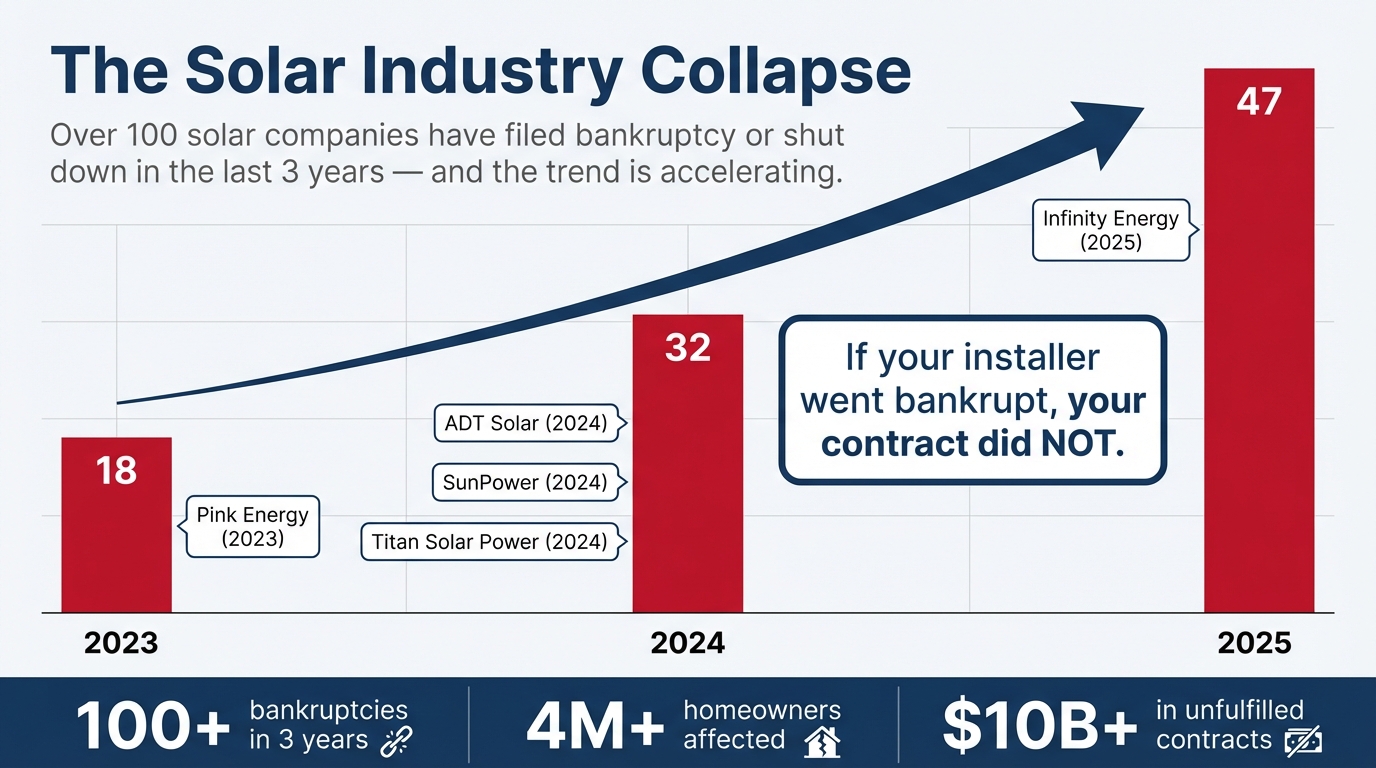
Did you know: More than 100 solar companies filed for bankruptcy or shut their doors in the last three years, according to reporting from SolarInsure and the Solar Energy Industries Association.
If yours is one of them, you're probably wondering the same thing every homeowner in your situation asks:
What happens to me now?
Here's the short answer: your solar company is gone, but your contract isn't. And neither are your options.
What Happens When Your Installer Goes Bankrupt, in Plain English
When a solar company files for bankruptcy, it does not cancel the deal you signed. Bankruptcy is a legal process that reorganizes or liquidates a company's assets. Your contract is one of those assets. So is the loan on your panels. So is the lease or PPA you pay every month.
In most cases, the bankruptcy court sells those contracts to someone else. That someone else is often a loan servicer, a private equity firm, or another solar company that buys the rights to your payments.
Here is what that means for you and your family in practical terms:
- The new owner of your contract expects to keep getting paid.
- The old company that was supposed to service your system, answer your calls, and honor workmanship promises is gone.
- The new owner often has no obligation (and no interest) in fixing a broken system they did not install.
That is the gap that catches most homeowners off guard. The obligations stay. The support disappears.
Why This Is Happening Across the Industry
You are not unlucky. You are caught in an industry-wide collapse.
Residential solar has been hit hard by higher interest rates, changing state incentive programs, and the end of favorable net metering rules in several large states. The result has been a wave of bankruptcies unlike anything the industry has seen before.
According to data compiled by SolarInsure, Wood Mackenzie, and the Solar Energy Industries Association (SEIA), more than 100 residential solar companies have filed for bankruptcy or ceased operations since early 2023. The U.S. Department of Energy has tracked a steep drop in new residential solar installations in California alone after the state's NEM 3.0 rules cut the value of excess solar power sent back to the grid.
This is not a small shakeout of weak players. Some of the biggest names in residential solar are on the list. That matters because when a large installer goes under, hundreds of thousands of homeowners can be affected at once.
What Happens to Your Contract
Your contract does not vanish. It gets assigned. That is the legal word for "sold to somebody else."
Contract assignment is a normal part of bankruptcy. The trustee overseeing the case looks at the bankrupt company's contracts, bundles them up, and sells them to recover money for creditors. Your solar lease, PPA, or loan can end up owned by a company you have never heard of.
What changes depends on the type of deal you signed. If you are not sure which one you have, our lease vs. PPA vs. loan guide breaks it down.
If you signed a lease or PPA: The solar company owned the panels on your roof. When they went bankrupt, ownership of those panels and your payment obligation was almost certainly sold to another entity. You are now paying a stranger for equipment nobody is servicing.
If you took out a solar loan: You own the panels. The loan itself was probably sold to a different lender or servicer. The equipment on your roof is yours, but your warranty coverage and repair path just got a lot more complicated.
Real Bankruptcies You Have Probably Heard Of
This is not theoretical. These are companies that sold tens of thousands of systems and then collapsed:
- ADT Solar: Once one of the largest residential installers in the country, ADT shut down its solar division in early 2024, stranding customers across more than 20 states.
- SunPower: A household name in solar for decades, SunPower filed for Chapter 11 bankruptcy in August 2024. Its leases and loans were sold to other servicers during the proceeding.
- Pink Energy (formerly Power Home Solar): Filed bankruptcy in late 2022 after attorney general actions in multiple states, including North Carolina and Missouri, over deceptive sales practices.
- Titan Solar Power: One of the largest installers in the Southwest, Titan ceased operations in mid-2024.
- Infinity Energy: Closed its doors in 2024, leaving customers in California, Texas, and Arizona without a service contact.
If your installer is on this list, or on the longer list tracked by state attorneys general, you are not alone and you are not without options.
How to Figure Out Who Owns Your Contract Now
This is easier than most people think. Work through these steps in order:
- Search your solar company's name plus "bankruptcy" in any search engine. News coverage and press releases will tell you the filing date and the case number.
- Check PACER, the federal bankruptcy court database. Basic searches are free. The docket will often name the buyer of the contracts.
- Look at your most recent bill or ACH withdrawal. If the name on the payment is different from the company you signed with, you have your answer.
- Call the customer service number on your current bill. Ask the person who answers the name of the company, who owns the contract, and who handles repairs.
- Check your email and postal mail for a "Notice of Assignment" letter. Federal law usually requires the new servicer to send one when a contract changes hands.
Write down every name you find. You will need it if you file a complaint or pursue a dispute.
Equipment Warranties, Performance Guarantees, and What Actually Survives
This is where bankruptcy causes the most damage to homeowners.
Solar systems usually come with three different warranties, and they do not all behave the same way when an installer goes under:
- Manufacturer performance warranty (usually 25 years): This comes from the panel maker, not the installer. It guarantees the panels will produce at least 80% of their rated output for 25 years. This warranty typically survives the installer's bankruptcy because it is backed by the manufacturer.
- Manufacturer product warranty (10 to 12 years, sometimes longer): Also from the panel maker. Covers defects in the panels themselves. This one usually survives too.
- Installer workmanship warranty (usually 10 to 25 years): This covers roof penetrations, wiring, mounting, labor, and installation quality. When the installer files bankruptcy, this warranty is often worth nothing.
That last point is the one that hurts. Roof leaks, failed wiring, loose mounting hardware, and bad flashing are the most common solar problems. All of them are workmanship issues. And workmanship is exactly what dies when the installer disappears.
Performance guarantees (the promise that your system will generate a certain number of kilowatt-hours per year) are also typically issued by the installer, not the manufacturer. After bankruptcy, those promises often go unenforced. The new servicer has no reason to cut you a check just because the system is underproducing.
Solar Credits, Net Metering, and Other Hidden Disruptions
There are a few more pieces of the puzzle that homeowners rarely think about until the bankruptcy hits.
Solar Renewable Energy Credits (SRECs): In states like New Jersey, Massachusetts, Pennsylvania, and Maryland, your system generates tradeable credits that can be worth hundreds of dollars per year. If your installer was managing and selling those credits on your behalf, that revenue stream can be disrupted or lost entirely after bankruptcy.
Net metering credits: If your utility account was set up by the installer, the bankruptcy can create paperwork gaps that cause missed credits or billing errors.
Monitoring service: The app or web portal that shows your system's production is often run by the installer. When they go under, the monitoring can stop working, and you lose the ability to tell if your system is even producing power.
What You Can Actually Do About It
If your installer went bankrupt, you are not stuck. You have real options. What you can do depends on three things:
- Your state. Consumer protection laws for solar are stronger in some states (California, New York, Texas, North Carolina) than others.
- Your contract type. Leases, PPAs, and loans each follow different rules after an assignment.
- How the system is performing. If the system is broken, underperforming, or was never installed correctly, you have more leverage than a homeowner whose system is working fine.
Possible paths forward include:
- Breach of contract claim. If the performance guarantee or workmanship promise in your original contract is not being honored, that can be grounds for a dispute against the new contract holder.
- Improper assignment challenge. Federal and state law usually requires written notice when a contract is sold. If you never got one, that is worth raising.
- State attorney general complaint. File with your state AG's consumer protection division. Many states (NY, NC, MO, TX) already have open cases against bankrupt installers.
- Better Business Bureau complaint. Creates a paper trail.
- Federal Trade Commission (FTC) report. The FTC has flagged residential solar as a high-complaint category.
- Class action lawsuit. Several are already open against bankrupt installers and the financial partners who bought their contracts.
These paths take time. But homeowners around the country are getting contracts reduced, repairs funded, and in some cases contracts cancelled outright.
What To Do Next
- Find your original solar contract. If you do not have a copy, the new servicer is required to provide one on written request.
- Confirm who now owns your contract using the steps above. Write down every company name.
- Pull the last 12 months of production data from your monitoring app (if it still works) and compare it to the performance guarantee in your contract.
- Document any repair problems, roof leaks, or service requests the old installer never resolved. Photos, emails, and text messages all help.
- Get free Solar Relief Assessment. A senior consultant can review your contract, tell you who actually owns it now, and walk you through what relief you and your family may qualify for.
Common Questions
Do I still have to pay if my installer went bankrupt?
In most cases, yes. The contract was probably sold to another company, and that company expects payment. Stopping payment without a plan can damage your credit and hurt any future dispute. Talk to a qualified consultant before changing anything.
Can I get out of my contract because the company went bankrupt?
Bankruptcy alone does not usually cancel the contract. But if the workmanship warranty is worthless, the system is underperforming, or the performance guarantee is being ignored, those can be grounds for a breach of contract claim against the new holder.
Who fixes my panels if they break?
The manufacturer still covers panel defects under the product warranty. Anything related to installation (mounting, wiring, roof penetrations) was covered by the installer's workmanship warranty, which often dies with the company. You may need to hire a new installer out of pocket, or pursue a claim against the new contract holder.
What happens to my SRECs or net metering credits?
The credits themselves belong to you, not the installer. But if the installer was managing the paperwork, you may need to contact your state's SREC registry and your utility to make sure nothing was lost during the transition.
I got a letter from a company I've never heard of asking for payment. Is this a scam?
Not necessarily. When contracts are assigned in bankruptcy, a new servicer usually takes over. Verify the company through your state's secretary of state business registry and cross-check against the bankruptcy docket on PACER before sending any money.
What if I want to sell my house?
A bankrupt installer makes selling harder. Many buyers refuse to assume a lease or PPA with an unfamiliar servicer and a dead workmanship warranty. We cover this in detail in our Home Sale Trap guide.
Is my situation big enough to do anything about?
If your monthly solar payment is more than a cell phone bill, and your contract runs 15 or more years, the total dollars at stake are usually well into five figures. That is more than enough to take seriously.
Sources & References
SolarInsure, residential installer bankruptcy tracker. Solar Energy Industries Association (SEIA), U.S. Solar Market Insight reports. Wood Mackenzie, residential solar market analysis. U.S. Department of Energy, Solar Energy Technologies Office. U.S. Energy Information Administration (EIA), residential electricity data. Federal Trade Commission, residential solar consumer guidance. New York, North Carolina, Missouri, Texas, and California Attorney General consumer protection actions. Better Business Bureau, solar industry complaint data. PACER federal bankruptcy court records.
Your Solar Company Is Gone. Your Options Aren't.
If your solar installer went bankrupt - or you're not sure who's even managing your contract anymore - the first step is talking to a senior consultant who can review your situation and tell you what relief you may qualify for.
Free Assessment
Talk to a senior consultant who can review your contract and tell you what relief you may qualify for.
No cost. No obligation. No pressure.

Sal Says
"More than 100 solar companies have gone bankrupt or shut down in recent years. If yours is one of them, your contract didn't disappear - it just changed hands."